Monday, 1 May 2017

Expansion

The hospital is going through some physical growth at the moment, thanks a legacy from the UK and some generous people in the USA.  I thought it would be good to explain (in lay terms, because, at the end of the day, I’m a pharmacist) some of the intricacies of how things are built here.

Being a mission worker overseas means you more often than not have to get involved in things that ordinarily, in your passport country, you wouldn’t.  That’s definitely the case for me at the moment, having general oversight of three building projects for a month or so.  We’ve been able to start a new area for outpatients to wait, a new surgery centre (with operating theatres and a new sterilisation room) and another house for expats to stay in.

Not being on ‘city power’ (read: mains electric) here at Guinebor means that the majority of things are prepared manually.  Even in the city most things are done manually as electricity costs and manual labour, apart from a salary, doesn’t.  The builders hire in generators when they really need to do something with electricity (i.e. soldering metal together to make a frame for the veranda on the new house).  Apart from that, right down to making the bricks, everything is done manually.  It’s crazy and amazing to watch at the same time.  Factor in the 45C daytime temperatures and you’ll have some understanding of the physical labour that goes into constructing a new building here.  There’s no Wickes’ (or wherever in the UK builders buy stuff….!) that we can just pop down to and buy bricks, mortar and so on.  Nope, we have piles of sand, gravel and sacks of cement delivered and dumped in massive piles near the construction site.  And then the hard work begins….

Step one of brick making:
fill metal mould with sand/cement mix
Step two:
level off the sand/cement mix in the mould,
whilst co-worker poses for photo

Step three:
carry filled mould over to drying area
Step four:
tip freshly made brick out of mould
Step five:
remove mould and start process again,
leaving bricks for two weeks to dry before using

I know very little about construction but I'm told that to ensure a wall is structurally sound, it has to have metal horizontal and vertical supports.  These are also made by hand from long lengths of metal:

Jean creating the metal supports

Marking out the building site for new surgery centre
A week after the picture above was taken,
the building site for the surgery centre looked like this!
These are the start of the foundations.  There are about 20 vertical pits like this,
which are about 3 feet square and at least 6 feet deep.  All dug by hand

Thursday, 16 March 2017

Visiting the locals

You may remember me saying in previous blog entries that I’ve been learning Chadian Arabic.  I started almost 12 months ago now, which seems impossible to believe!   However given that I was only doing a 1.5 hours lesson twice a week and wasn’t getting chance to do any more study because of my work at the hospital, progress has been somewhat slow.

A change in circumstances has meant that I am now having one lesson a week for 1.5 hours.  As I’m in the habit of setting aside time for Chadian Arabic learning twice a week, I don’t want to lose that momentum.  So I’m going to try and visit local ladies in Guinebor II (the village of the hospital and where I live) at the time when I previously had my second lesson of the week.  I’ve enlisted the help of a member of hospital staff, Mariam, who also lives in Guinebor II and who speaks Chadian Arabic and also French.  Most of the locals in Guinebor II only speak Chadian Arabic, which is one of the reasons I want to learn it.

Yesterday afternoon was Mariam and my first visit out into Guinebor II.  I’ve asked Mariam if we can visit the wives and families of our staff that live in Guinebor II.  So yesterday we visited the home of one of our guards.  Unfortunately he and his wife were out, but his mother was around.  She didn’t know we were coming, so it was probably a bit of a shock to see the Nasara (white person) turning up! 

It’s not appropriate to take photos here when you don’t know people, so I’m going to try and paint a picture with words of what it was like out in the village yesterday:

Under the perpetually-blue sky of Chad, Mariam and I walk up to the house which is made of mud bricks and overlaid with plaster.  It’s a rectangular building with three room in a row about 10 foot square, each with a metal door and in front of these rooms is an open veranda area, the front of which is covered with a once-red-but-sun-tarnished piece of fabric, which is blowing in the gentle warm breeze of the late afternoon.  The sandy-floored yard area in front of the house is fenced off with reed mats and is open on one side, which is where Mariam stands and calls out ‘al-salam alekum’ (hello).  There are several ladies and children in the yard.  One of the ladies, with a small child strapped to her back with an old towel, is sweeping the sand-dust floor with a locally made brush made up of many reeds tied together.  Some children are sat on a colourful mat chatting.  The matriarch of the house (the mother of one of our hospital guards) knows Mariam and comes over to greet us.  She shakes Mariam by the hand and the Chadian Arabic begins.  By piecing together the odd word I recognise, along with her gestures, I can tell that Mariam is explaining that I’m learning Chadian Arabic and that I want to hear it being spoken so that I can get better at it.  The mother shakes me by the hand and greets me, asking how I am.  I reply that I’m doing fine thanks and she smiles, finding it funny, but good, that the Nasara can speak a bit of Chadian Arabic.  She gestures to one of the other ladies to bring a mat.  We are furnished with a large (6x3 feet) green and black mat, typical of many Chadian houses in that it’s made of thin woven plastic strings.   We take off our shoes (read: flip flops) as is customary, no shoes go on mats, and sit on the ground in the yard area on our mat.  In order to make the mat even more ‘attractive’, a small woven carpet is brought out and put on top and I’m told via gestures from the mum that we’re to sit on the carpet, not the mat.  Mariam and the mum chat away and I pick up odd words and phrases.  Periodically Mariam translates what’s being said into French so that I can follow along.  Whilst the two ladies chat, I look at my surroundings through the gap in the yard ‘fence’.  There are a fair few trees around providing welcome shade to the houses from the scorching sun (afternoon temperatures are now over 40C). There are many other similar houses around.  People live in close proximity and there are shared toilets of the long-drop variety.  The ones in this area have brick walls but sometimes there’s only some corrugated iron surrounding you to preserve your dignity!  Three varying-sized goats wonder past.  They must belong to someone but goats are free-range here.  As were the five or so chicks that were picking around in a pile of dust.  I’m brought out of my gazing around when a strong gust of wind picks up one side of the large plastic mat and it envelopes me!  Cue some ladies strategically placing some nearby large stones on it to keep it in place on the ground.  There was a nice warm breeze blowing during our visit, but given that it’s not rained since the start of October, wind here always means dust.  A bit later on, two men walk past in the distance selling their wares.  One is selling football shirts, displaying them on coat hangers and carrying them at shoulder-level so as to make sure they’re visible to potential purchasers.  The other man is pushing a small two-wheeled cart, on top of which are some locally made sweets that look like seaside rock but are much softer.  They are ambling along chatting to each other when all of a sudden they stop, look behind them and then turn back to the house they’ve just passed.  Someone wants to buy some sweets and has called them over.

At this point, Mariam and the other lady decide they’re going to test me on my Chadian Arabic.  ‘Da cenu?’ (‘what’s that?’ they ask, pointing at a tree).  I reply that I know, but I can’t remember which the plural version is and which the singular is!  They help me out and then point to the dog that’s been lazily sleeping behind us the whole time.  I always mix up the word for dog (kalib) with the word for book (kitab) and of course, I said the wrong one!  The next thing they point to are the chicken.  Ah ha I think, I definitely know this one (at the start of lessons with our teacher, chicken was one of the first words we learned and so with our limited vocabulary, whenever the teacher asked us what we’d eaten that day, or what we’d bought at the market, the answer was often chicken, as we didn’t have a great repertoire of items to say!!).  I got that word right and the mum smiled broadly and shook my by the hand as a way of saying ‘well done!’

They both encouraged me a lot during our time together and said ‘you will get there’. 

After an hour on the mat, it was time for Mariam and I to leave, as it was going to start getting dark.  We thanked the mum very much and walked the 5 minutes back to the hospital together along the dusty tracks.

Hopefully this will be the first of many visits to some of the ladies of Guinebor II :)

Thursday, 23 February 2017

Fractured: an update

After my last blog, I thought people would like to know how David (not his real name) is getting on.

Happily I can say he is doing well.  He had his surgery at 7.30am the morning after he arrived with us at Guinebor II Hospital.  Our senior nurse surgeon successfully put a metal rod and screws in his femur in order to bring the two ends of bone together.  It wasn’t an easy process he tells me.  The day after surgery, David was wide awake and chatting away to us.  We wheeled him down to our x-ray department and took some pictures of his leg to check positioning of the rod and screws.  The nurse surgeon was ecstatic to see that the placement of the rod and screws was good and that the two ends of bone were well aligned.  Unfortunately, we don’t yet have any way of printing out our x-rays, we have a digital x-ray machine and look at the images on a computer screen.  Hopefully in the future we’ll be able to print out peoples x-rays.  As such, we wheeled David over to look at the computer screen and see his x-ray.  Being a nurse, he knew what he was looking at and the nurse surgeon explained how well the surgery had gone and that the metal rod was in a good position.  David’s sole response was ‘gloire à Dieu’ (glory to God).  He was so pleased with the outcome of his surgery. 

The next challenge was to fit David out with some crutches so he could be mobile.  He is a tall guy, measuring 192cm (6 feet 3 inches) and none of the crutches we had in stock were long enough!  We have a man in town that makes crutches for us out of wood.  This necessitates a phone call to him to place an order.  We have a standard size that we usually ask him to make, that’s adjustable to a certain extent, but David required a size over and above that which we usually stock here.  My colleague called the crutches-maker and explained as best she could the size of the crutches we needed, and the length we needed them to be adjustable to.  This was done in French obviously, which is not her first language as she’s American.

'Just when you think you have arrived at communicating
well in your second language, this happens....'

We had a good laugh at the size of the crutches that materialised, and so did David!  Fortunately, someone on site at the hospital was able to adjust them down to a size suitable for him.

So as for his leg, David is doing well.  The incision wound is healing well.  What is concerning now is that he’s having near-constant headaches, which is probably a concussion from the accident.  He’s still with us in hospital in order for us to keep an eye on his incision wound, but also to monitor his headaches.  He is doing better every day.

Thank you to those who have been praying for him.  I told him yesterday that a lot of people in the UK and elsewhere around the world are praying for him, and he is so very grateful.  Please continue to pray for his recovery.

Wednesday, 15 February 2017

Fractured

At the end of last week, my Chadian pharmacist colleague and I were having to frantically buy plaster of Paris.  All part and parcel of running a pharmacy in a hospital here in Chad.  As I’ve no doubt recounted numerous times, it’s not just medicines that we have to ensure are available, but also many other medical supplies.

We’d had a good stock of plaster of Paris, ready and waiting for anyone who needed a limb putting in a cast.  All of a sudden, the hospital was seemingly inundated with people with fractures and our stock was exhausted in a matter of days.  The senior nurse surgeon who works here came into the pharmacy asking us to ensure that we had a good stock of this product.  We went to the wards where he pointed out three guys who were waiting for plaster casts; two with leg fractures and one with an arm fracture.  And we’d run out of plaster of Paris.  I hate it when that happens!  Within a few hours we’d managed to find enough in town to get all of these patients in their respective casts and we breathed a sigh of relief.

Why so many bones fractures?  They are mainly due to road accidents.  Many people travel on motorbikes as they’re a cheap form of transport.  It’s very unusual to see one person on a motorbike.  A motorbike owner will always offer a lift to someone else travelling in the same direction.  Throw in the traffic here and the fact that people carry all sorts of stuff on the back of a motorbike and you’ve soon got a recipe for fractured bones. 

Two on a motorbike, plus a bench and some paint

Fast-forward to this morning.  I was in the pharmacy and my Chadian colleagues were talking in one of the village languages and I couldn’t understand what they were saying.  Apart from the fact that they kept saying the name of one of our nurses here (let’s call him David, that’s not his real name.  He’s in his mid-twenties).  I asked what was up with David.  They said they weren’t sure but that someone had come in saying he’d been involved in an accident last night and was asking if he was in our hospital.  ‘No’ my colleagues replied.  The man departed but my colleague tried calling David’s phone.  No answer.  He tried another nurse who lives near David, who said he’d try and find out what was going on.  A few hours later he calls back saying that David is in the central hospital with a fractured femur after being knocked off a motorbike by a car last night.  Cutting some to-ing and fro-ing short, eventually our hospital driver goes and collects David in our ambulance.  He brings him to us at Guinebor Hospital, so that he can be in a place he knows and also much nearer his home, so that it’s easier for his family to visit.  We hear that he’s received little in the way of care at the central hospital because he didn’t have much money with him.  No money up-front, no healthcare it would seem.  He arrives with us with a copy of his leg x-ray and a makeshift cast on his leg made out of cardboard and some bandages. 

Our senior nurse surgeon, the one who asked us to make sure we’ve got enough plaster of Paris in stock, is hoping to operate on David’s leg very soon.  And it's likely he’ll be using some of the remaining plaster of Paris that we frantically acquired last week.  I’m glad David is here with us at Guinebor now, amongst colleagues who will care for him.  The staff here are like one big family and it’s hit me that ‘one of our own’ has had to endure such a serious accident and then apparently sub-optimal care at the central hospital.

Those reading this who pray, please pray for David’s recovery and also for all of the staff at Guinebor Hospital as we seek to ensure we have enough supplies and enough personnel to deal with all the cases that come through the door.  Thank you :)

Thursday, 22 December 2016

Joyeux Noël from Guinebor II Hospital

This afternoon, after much planning and preparing, we held our Christmas celebration for the patients, relatives, staff and local religious and community leaders.  A lot of Churches in the UK have supported the work of Pastor Djibrine here at G2 hospital, thank you.  

I thought it would be good to take pictures throughout the day, so here they are, with some descriptions as to what’s happening!  The event itself went well, even though to the untrained eye it may at times have seemed a teeny-weeny bit like mini-chaos!  So without further ado, here are the pictures taken today.  Merry Christmas from the desert of Chad J

A group of ladies who live in the village of Guinebor II did the bulk of the food preparation yesterday.  It took all day.  Not surprising when you’re catering for 200 people:


This lady is taking a completed bowl of cooked meat (I forgot to ask what the meat was, it was likely goat) to the food storage area at the hospital (aka my veranda):


The food that was prepared was meat, gateaux (small plain doughnuts) and prawn crackers.  Here it all is, ingeniously stored in plastic containers that you may *think* are rubbish bins but aren’t actually used for that purpose in this case, you’ll be pleased to know!


A pick-up arrives with the first lot of chairs.  We hired in a canopy, chairs and a sound system (which worked fairly well with only semi-frequent cuts):


The canopy was put up in what seemed like the blink of an eye:


Pastor Djibrine went to the wards to tell the patients and their relatives that the celebration would be happening this afternoon and that they were all invited:


People started assembling just after the time we were meant to start, meaning that we actually started an hour late (not bad!):


A choir from a local Church sang some songs, accompanied by some swaying:


A few of the hospital staff did some readings and sang some songs:


There were also three Bible readings, two in Chadian Arabic and one in French, about the birth of Jesus.  A pastor from a local Church gave a short talk in Chadian Arabic about the prophecies of Jesus’ birth.

A local lady who we know well at the hospital (she has a food stand outside where a lot of the staff eat their lunch) joined us for the event:


As the event was finishing, it was all hands to the deck to plate up the food and hand it out along with water and a fizzy drink:


The food was appreciated, as evidenced by the choir pictured here:


The food-preparation ladies were around until the very end helping to clear up, here’s a photo of them heading home:


Monday, 28 November 2016

A typical day

I thought people may be interested to read, and see a bit of, what a typical day here at G2 looks like for me.  Here is a typical Wednesday for me during the past month.

5.45am: the alarm goes off and I hazily hit the snooze button multiple times before relenting and realising I really *do* have to get up and get ready.

6.40am: Tabitha, my lovely house-helper, arrives.  She comes to my house three mornings a week to do my laundry (all by hand), clean the house and sweep the floors (a never-ending task with all the dust).  Here’s a picture of Tabitha arriving at my house in one of her pretty lafayes.  You may notice something jutting out from her back – that’s her 4-month old daughter, Lea!

The lovely Tabitha
6.45am: I leave the house, with my work bag and a 1.5 litre bottle of cool (ish) water in its insulated carrier, to go and join some of the other staff for our morning devotions.  No picture of me at this time of the morning…..I wonder why?!

7am: The working day starts.  At present, the pharmacy also doubles-up as the payment window for patients who need to pay for their lab tests, or to attend some of the clinics.  One of the Chadian pharmacy staff is currently on holiday, so in order to practice my slowly-improving Chadian Arabic, I am running this payment window until the end of November.  It’s a great way of meeting the local people and they find it hilarious that the white woman is speaking a bit of Arabic.  Some of them understand my accent, some don’t!  Everything goes ok with regards to me being able to carry out the functions of this payment window, as long as the patient doesn’t go off-script!  As soon as they ask me something that’s not to do with the price they need to pay, or where to go after paying, I get a bit stuck.  Fortunately there’s always a member of Chadian staff nearby who I can call on to help me out with some translation into French.  They’re all very patient with me which I’m grateful for.  Just to prove that I really am doing this, here’s a picture of yours truly working in the payment window:

Can you spot me?!
8am: a member of Chadian staff from the operating theatre comes to the pharmacy with a request for medical supplies.  The pharmacy doesn’t just stock medications but also a whole variety of medical stock that no UK pharmacist would ever need (want?!) to know about.  It’s been a steep learning curve of needle gauges, NG tube sizes and aperture fittings, plaster of Paris and suture material.  The last one I’m still getting my head around.  Do they want absorbable or non-absorbable stiches?!  What the hec is the difference between size 3-0 and size 0?!  What does reverse cutting mean?!  I’m getting there, albeit with many questions.

What?!  These are all sutures?!
What's the difference between them all?!
9.30am: the payment window is starting to quieten down for a bit whilst the patients wait to see the nurse or doctor.  Audrey, my Chadian pharmacist colleague, brings me his monthly order for the government-run wholesaler in town, for to check over.  He’s very organised which is a blessing and any alterations I make are usually fairly minor.  It will take at least two weeks, and about three trips into town for Audrey, before we get the supplies he’s ordering.  If we get half of what we need from the main wholesaler, we’re doing well.  The rest we have to try and get from elsewhere (at a higher price).

10am: one of the expat workers comes to the pharmacy to ask me a question.  They ask in English because it’s easier and quicker.  When they arrive I’m part-way though talking about the monthly order with Audrey (in French) and a patient comes to pay for their lab tests, who speaks Arabic.  It’s not uncommon to speak English, French and Arabic in the space of 5 minutes!

11am: Djiddo, a local guy with a private pharmaceutical wholesale business, arrives with a small order we’ve had to make because the government-run wholesaler didn’t have this item.  Here we are posing in the pharmacy with the item he’s brought: boxes of latex gloves.  Yes, we really are posing with boxes of gloves……

Djiddo (left) arrives with some much-needed boxes of gloves.
Audrey (Chadian pharmacist) is on the right, Cleopas (pharmacy assistant) is in the front
11.30am: My 1.5 litres of water has run out (it’s cooler now so it lasts longer, in hot season I’ve drunk it all by 10am).  So I quickly head back to my house to restock with another one.

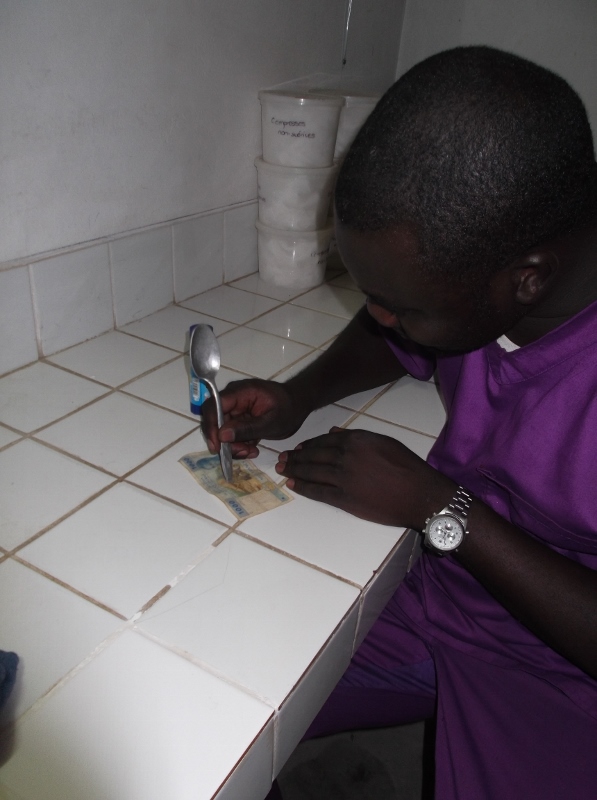
12pm: Chad is a mostly cash-society.  There’s only one shop in town (that I know of) that accepts card payments.  So the money gets handled a LOT.  Working on the payment desk, I get handed a lot of money and 99% of it is paper notes (I nearly wrote paper bills there……can you tell I’m surrounded by Americans now?!).  You can imagine the state of them after they’ve been in circulation for a while.  The Chadian pharmacy staff have become very adept at resurrecting worn out (read: falling apart) money.  Most days I get given at least one or two, which I pass over to my Chadian colleagues to clean up so we can put it back into circulation.

Stage one: clean the money with some washing powder
and water and then allow to dry
Stage two: using a stick of glue, piece the broken note back together,
carefully making sure that the join is not visible.  Allow to dry
12.30pm: I head back to the house for some lunch, the second 1.5 litre bottle of water now having been consumed.

1.30pm: I check that the pharmacy is ticking over ok and head back to the house again to do some paperwork for BMS, accompanied by my third 1.5 litre bottle of water of the day.

3.30pm: Time for our Chadian Arabic lesson with our long-suffering and very patient teacher, Abakar!  I can’t believe I’ve been learning it for 9 months now.  I still feel like I know nothing but as I know from learning French, I will get there, eventually.

Mid Chadian Arabic lesson with Abakar
5pm: Arabic lesson is finished and I water the garden.  Trying to keep plants alive here is a lot of work when it’s not rainy season.  Given that it’s now not rained for 6 weeks (and won’t again until next June), it means watering by hand for the next 8 months.  Every now and then though, you’re rewarded with a splash of colour, like I was when this lovely lily bloomed a few weeks ago:

Beautiful, colourful lily amongst the brown of the dust
6pm: Time to make some dinner.  One this particular evening, I decided to make my Chadian version of egg, chips and beans!  Cue a couple of eggs with pale yellow yolks (the chickens don’t have a great diet here), plantains instead of potatoes, and a can of baked beans imported from France, that I have to add ketchup to in order to make them taste remotely tomato-ey.  Guavas for pudding, yum yum!

All the ingredients for my eggs,
plantains and beans, followed by guava
7 – 8.30pm: Time to relax in front of a dvd, usually an episode or two of a box set.  I’ve watched all four series’ of Ugly Betty, so now I’m onto Gilmore Girls!

9pm: Time for bed.  Early for me who used to go to bed around 11.30pm in the UK, but given the early start and the heat (despite it now being ‘cool’ season it’s still 35C in the middle of the day), you’re tired much more quickly here.  I tuck myself in under my mosi net and drift off, waiting for the next 5.45am alarm….

Friday, 21 October 2016

My Chad life: your questions answered (part two)

Welcome to part two of my questions and answers blog.  Below are the remaining questions that I’ve been asked.  Hopefully they will enable you to have a greater insight into my work and life here.

What jobs do you do in the hospital other than pharmacy stuff?
Many!  I work on the cash desk that takes money for lab tests.  This helps me practice my Arabic.  It goes ok as long as the patient doesn’t go off script!!  I can tell them the price, take the money and direct them to where they need to go next.  If they ask me something else then I get a bit stuck and need to ask a Chadian colleague to bail me out.  The patients love the fact that the ‘nasara’ (white person in Arabic) is attempting to speak something other than French.  I take meeting notes at our monthly management team meetings.  I help organise work rotas for the hospital guards.  I supervise the lab.  I have some input into organising the nurse rotas and their holidays.  Another job on the current ‘to-do’ list is to try and figure out what’s gone wrong with the computer software for our new digital x-ray machine (anyone who knows anything about medical imaging please, please get in touch!).  I’ve also written a project funding proposal to support the work of Pastor Djibrine, the hospital chaplain.

Can you give a breakdown of staff numbers at the hospital – ex-pats and Chadian?
There are 67 Chadian staff here and 6 ex-pat staff.

What hours do you work?
The working day starts at 7am and we have a short worship time for staff before this at 6.45am.  The working day ends at 3pm but often extends due to the volume of patients coming to the hospital.  I work these hours Monday to Friday.  Once a month I work part-time on the weekend to make sure that the wards are topped up with medical supplies whilst the pharmacy is shut.

Spare time – how much do you get, what do you do and are there opportunities to make meaningful relationships?
I have every weekend apart from one a month completely work-free which is great.  I’ve previously mentioned that I’m involved in a weekly English-speaking Bible study and so that helps me meet people and through this I’ve got to know some great people.  There are limited entertainment options in Chad!  There’s a cinema here in the capital which shows some English films with French subtitles.  I have now finally been there and it was amazing – a huge room with proper cinema seats, screen and….most importantly…air conditioning!  That alone was worth the £3 entrance fee!!  There are some nice French-style cafes where I’ll meet friends for a snack.  If I’m feeling suitably robust I’ll go to one of the markets and do some bartering.  You need to be in the right frame of mind to do this, but it’s amazing what you can find in the markets.  Other than that, I’ll go to friend’s house, watch a film, watch part of a box set, read.  That sort of thing. 

What contact do you have with the local, indigenous Church?
Our hospital Chaplain is a Chadian from one of the many evangelical denominations here.  So through him, the hospital has strong links with the indigenous Church.  We also have links with the Chadian version of the Evangelical Alliance.  When I’m not at the English-speaking service (see below), I try and attend a local Chadian Church.  There are various evangelical denominations here which have various styles.  I’ve been drawn to one in particular because of its size (relatively small at around 100 people) and friendliness.  However the drawback is that it’s in Arabic and not French, so I don’t understand a great deal (yet)!

What is Church life like for you - where do you worship and what is the service like?
Twice a month an English service is held at one of the other mission compounds in town, so I attend that as it’s refreshing to worship in my mother-tongue.  The service is fairly similar to a service in the UK.  On the other Sundays I try and attend a Chadian Church service as I described above.  The service consists of a lot of singing (mostly from memory, which can be a bit tricky for me as I don’t know most of the songs!).  The singing is led by a small choir.  Then there are the announcements.  Lots of announcements.  They often go on for around ten minutes!  Then prayers of intercession, the sermon and a blessing.  At the end of the service everyone stands up, files into the courtyard and shakes hands with everyone else. 

Do you have contact with any Chadian people other than those you meet through the hospital?
I’ve a Chadian friend and her family who I met whilst here in 2013 through Rebecca (previous BMS worker here).  I try and see them as often as I can.  I meet some Chadians at the English Church service and obviously at Chadian Church too.  I also get to meet the people who run the small businesses outside of the hospital.

What sort of things are you learning that you would not have the opportunity of learning at home?
How to operate in a completely different culture.  The ‘way’ things are done here is so completely different than in the UK.  That can both be interesting and very tiring at the same time.  This culture is an honour-shame culture as opposed to the guilt-justice culture in the West.  It’s hard to explain but the culture here is much more indirect, so as not to bring shame on anyone.  I’ve been trying to think of a specific example to explain what I mean, but it’s so subtle it’s hard to think of a specific example.  I’m also learning Chadian Arabic.  Definitely wouldn’t have had that opportunity in the UK!  I’m also learning how to drive Chad-style.  On first look it would appear that there are no rules of the road and everyone just does what they like.  However there are many unwritten rules, such as ‘pull out at the crazy T junction when the oncoming traffic is a reasonable distance from you (but still quite close).  Oncoming traffic must give way’.  Another is that motorbikes can weave in and out of traffic, undertake and overtake, and drivers of 4-wheeled vehicles must utilise 360 degree vision to ensure they don’t hit one.  I’m also getting the chance to learn a bit about surgery when I hear other expats talking about their day and I also learn a bit about tropical disease management.

What is your favourite thing about living in Chad?
The fact that the sky is blue for about 350 days a year!  I also like getting to learn more about the culture and traditions and just simply getting to know local people.

What is a typical evening meal?
For a Chadian it would be boule (a stodgy white mass often made of maize flour, other African countries call it other things such as fufu or ugali).  They would typically eat this with an okra-based sauce that may or may not have pieces of meat (usually goat) or smoked fish in it.  For me, it’s similar to in the UK: spaghetti bolognaise, curry and so on.

What’s the most challenging thing you’ve had to do in Chad?
There are a few things!  Doing staff disciplinaries was never easy when I was doing more HR earlier on.  Thankfully we now have a Chadian administrator who does them!  Seeing extremely ill children who should possibly have been brought into hospital earlier is disturbing.  Hearing about locals refusing health interventions because of their beliefs about death is challenging, when you know the procedure would likely save or significantly prolong their life.  My first (and thankfully only, so far) car accident was challenging.  Fortunately no-one was harmed.

What’s the most interesting thing you’ve done in Chad?
This would have to be visiting Chadians in their homes, eating with them, drinking their sweet tea and generally getting to know them, their families and their culture.

What are your short term and long term goals for being over there?
Short term would be to function adequately in French, continue to work alongside my Chadian pharmacy colleagues to ensure good stock control of medical supplies and help where I can in the hospital.  Long-term would be to be fluent in Chadian Arabic so that I can converse independently with the locals at the hospital, help them understand their medicines well, visit people in the community of Guinebor II and share my faith with them, get involved in pharmacy-related meetings in the capital and make links with other pharmacy workers in other hospitals.