Tuesday, 30 July 2019

Rainy season - the positives


Usually when rainy season hits, I’m blogging about increased mud, dodgy (ok, dodgier) roads and heightened malaria risk.  All that is still true and an everyday reality.  However, there are some positives of the rains hitting!

The first rain at Guinebor this year happened on 27th May.  I did my traditional dance in the first rain of the year (ok, it’s actually a crazy run around with my arms in the air) – it is SUCH a relief to feel the rain after the drudge of at least 2 months of hot season, where it’s continuously over 35C by night and over 40C by day.  I get totally soaked and it’s fabulous!  This year I was joined by BMS short-termer Dr Jon.  Kudos to Dr Jon who arrived for a 4-month stint with us at Guinebor at the height of hot season at the start of April.  We were watched bemusedly by our friend Michaela, who watched the rain fall from the comfort of her veranda!


After dancing like a fool in the first rain of 2019!
Note the brown ground in the background

So 27th May was the first rain since October 2018!  It’s amazing that after just a few rains, the brown, dry, dusty ground turns green.  The following pictures show the same part of the housing area of the hospital compound at three different times at the start of rainy.  It’s so cool that the grass seeds remain dormant under the ground all dry season!


19th May 2019

7th June 2019

29th June 2019

30th July 2019

We have gardens, of sorts, at our houses here on the compound.  During the dry season we work hard watering them to keep some sort of greenery around.  Every now and again a plant will flower in dry season, but not too often.  However, in rainy season – flowers abound!


Wildlife also seems to abound more in rainy season.  There are often small birds around our compound but this rainy season we’ve seen a lot of sunbirds.  Or maybe it’s just one that we’ve seen a lot?  Beautiful creatures that have iridescent colours.  The colours of their feathers change depending on the angle of the sun on them.  Totally amazing!  Unfortunately, they’re quite elusive and I’ve never had my camera around when I’ve happened to see a sunbird on a small tree outside my front door.  So you’ll have to do with a stock photo I pinched off the internet (thanks Google).


Finally, I saw something for the first time ever a couple of Sundays ago on the way back from church.  A rainbow behind clouds!  I’d heard about this phenomenon that happens during rainy season and seen pictures from a few years ago when it was last seen here.  It was great to witness it with my own eyes.  The picture below doesn’t do it justice really, but you get the idea.


Beauty in the desert and a privilege to see :)


Wednesday, 1 May 2019

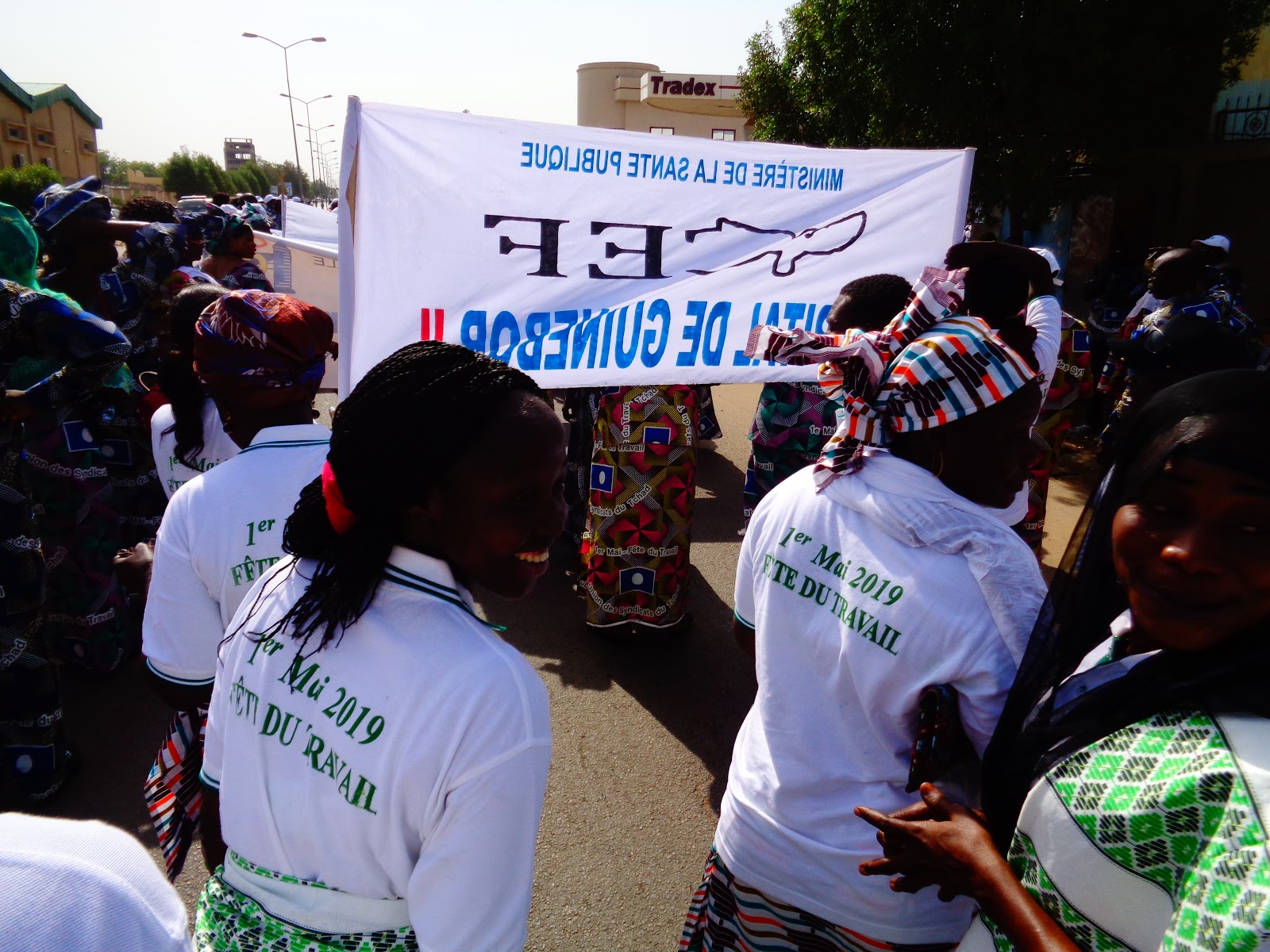
Fête du Travail 2019 - Labour Day 2019


Today, 1st May, is a public holiday here in Chad as it’s Labour Day.  I am sat here in my house at Guinebor, early afternoon, reflecting on the fun (but VERY hot) few hours I just spent with my Chadian hospital colleagues.  All organisations are invited to celebrate Labour Day by marching in the streets of N’Djamena and into a stadium in front of dignitaries.  For security reasons in previous years, I’ve never done the march on Labour Day, but today I did!

As a hospital we all wore the same t-shirt with the hospital name and logo on the front and ‘1er mai 2019 fête du travail’ on the back.  We each had one of two fabrics to make a skirt or trousers from.  It was great to see how different people had come up with different designs and we all looked great marching alongside each other!

At 7am this morning, I drove into N’Djamena with a short-term doctor from the UK and six members of staff.  We parked up at the pre-arranged place and met other members of staff there.  We took a few photos as we waited for the staff who had started the march earlier to get to where we were, near the stadium.


Photo while we wee waiting for the others

Altogether, there were 45 members of Guinebor Hospital staff marching behind our banner, which was a great turn out.  It was a fun atmosphere!   As we joined the rest of the hospital staff, loads of people were trying to get in their organisations into correct order, which caused some amusement (to me).  Guinebor Hospital had been assigned to march in third place, behind a couple of other hospitals.  I think that’s where we ended up, but I’m not totally sure.  


Getting organised behind our banner
Lined up and ready to go!

After a few starts and stops on the road leading to the stadium, we eventually made it inside.  A guy on a loud speaker introduced us ‘et voici l’hôpital de Guinebor II’ (and here is Guinebor II Hospital).  We marched past the dignitaries who were sat on satin-covered chairs in a tiered pavilion with shade-cover.  Then we stood underneath some canopies as we watched everyone else file in.  There must have been at least 50 organisations altogether, so that took a while.

Watching the other organisations march in


By this point, it was starting to get hot.  But we had to listen to a few speeches first before we could head to a restaurant to eat a sandwich and drink a coke altogether.


Enjoying a sit-down with a coke, waiting for our sandwiches


Such a fun morning celebrating our work at the hospital with my work colleagues!

Wednesday, 17 April 2019

A Jacqueline* of all trades?


*I know this is usually Jack, but I’m female so I thought I’d make it a more relevant phrase for me 😉

I have spoken in previous blogs about some of the ‘other jobs’ I do here at Guinebor II Hospital.  Despite being a pharmacist, and that being the main reason I’m here, long term mission work always lends itself to opportunities for learning a whole gamut of other knowledge and skills.  Some of which I’d have preferred not to have learned, but you know, needs must.

·      Solar energy production and system maintenance
We’re not on mains power here, so the majority of our power is harnessed from the sun.  Including for my house, which is where I’ve learned the bulk of my solar power knowledge.  Panels, regulators, inverters, batteries are all words I’ve learned in both the languages I speak.  Is it a 12v or a 24v system?  Should we have an inverter?  How many watts should the inverter be?  How many watts are each panel? Which direction should we put the panels facing so they get the most of the sunlight?  Why is the inverter alarming?  Has it fried with the heat and dust?  Or is it because the regulator has died?  Or worse (because: cost) have the batteries died?  Slight panic arises when it’s cloudy for more than two consecutive days.  Especially when that’s in hot season, or rainy season, when it’s hot and/or humid and you could really do with cool water from the fridge and a fan.  Two or more consecutive cloudy days often means there’s not enough sunlight to charge the batteries, meaning a potential lack of electricity.  Cue lots of washing of the panels to try and harness as much of the cloud-blocked sunlight as possible!

·         Septic tanks
Whether it be the pit latrines at the hospital or the septic tanks for each house, I’ve learned a lot about how to ventilate them to a) dissipate the smell and/or b) stop a build-up of nasty gases that could theoretically cause an explosion.  I’ve also learned the process of finding a septic tank emptying service (process: go into N’Djamena, find where the tankers are parked, copy the phone number from the side of the tanker, call the number and arrange for the tanker to come to the hospital.  Be prepared to pay a high price for your pit latrine or septic tank to be emptied)

·         Construction terminology
My French vocabulary in this arena has soared.  Cornières, contreplaqué, ciment (ok, some of them are easier than others), vices, raccourt, perceuse, planches, sable, gravier, fils d’attache to name a few.  Not sure if this knowledge will ever become a ‘transferrable skill’ but you never know!

·         Chadian labour laws
With almost 90 members of staff, there’s almost always something cropping up from an HR perspective.  Some of the laws here are truly baffling to me but as a visitor to this country, I have learned to accept them, as there’s nothing I can do to change them, and we need to comply with the law of the land.  Basically, the labour laws here are extremely pro the employee.  Which if there is a rogue employer is great and needed.  However sometimes these laws can get a bit frustrating in certain circumstances!

·         Staff uniforms
We try and ensure each staff member gets a new uniform each year.  This involves asking someone to buy rolls and rolls of fabric in the market.  Arranging for one of four staff members who do tailoring to come and chop of a length of it and make scrubs for individual staff members.  Oh and don’t forget the yearly negotiation of how much we’re going to pay for each set of scrubs made!  Last year this literally took weeks to negotiate……

·         Management training
Now that we have department heads for every department in the hospital, it’s giving good opportunities to guide and coach some of our Chadian staff in both change management and staff management and empower them to take charge of the development and progression of their departments.  This is an exciting stage for the hospital as we develop our Chadian staff to be leaders and for me, learning to delegate to them.

I hope that’s given a bit more insight into some of the many things I’ve learned and continue to learn here in Chad!  It leads to a very varied life 😊

Monday, 25 February 2019

A patient update and something quite unbelievable (but true)


I thought people who heard me speak on my last home assignment would be interested in an update on Abderamane, the man who had a fractured leg and arm after a motorbike accident and who had sought 7 months of treatment with a traditional healer (which didn’t work) before coming to be treated at Guinebor.  When I returned to Chad last November, Abderamane had already left the hospital after receiving surgery on his leg and subsequently his arm.  Apparently, all had gone well.  It wasn’t until the start of February that I saw a guy on crutches at the entrance to the hospital and I thought to myself ‘I recognise that guy’…..It was Abderamane!  Full of smiles and walking adeptly on his crutches, he told me he had come for a check-up with the surgeon.  He welcomed me back to Chad (well, he wasn’t to know I’d already been back 3 months!) and asked if I’d had a good time in the UK.  A few days later, a Wednesday, we were going around the inpatient wards praying for patients as is our habit on a Wednesday morning.  We go around in twos or threes offering to pray for patients and I was with one of the male Chadian staff members.  There in one of the beds was Abderamane.  Turns out that he needed further surgery on his leg.  He was happy for me to pray for him and I did so.  The guy is amazing, always smiling despite his ongoing health issues with his leg (he broke it back in September 2017, so 18 months ago now).  Fast forward to today and I bumped into Abderamane in outpatients!  Zipping along nicely on his crutches, he told me he had come for a dressing change.  He thanked me for all we’d done for him and I told him it was no problem, it’s what we’re here for.  I’m so glad to have had these further brief catch-ups with Abderamane and to hear that he is on his way to recovery and is extremely grateful for the care he received here at Guinebor.

Early the other morning, I called across to Christophe, one of our nurses working in the emergency room, asking if he’d seen Kalbassou (my Cameroonian nurse-surgeon colleague).  ‘No’ he replied, ‘but I need him in the ER, we’ve got a young girl here who has been bitten by a panther!’ ‘Really?!’ I exclaimed.  Christophe shrugged his shoulders ‘I’m not sure if it’s exactly true but she’s been bitten by something’.  I continue on my way, find Kalbassou and ask him to go to the ER.  I then get busy in the pharmacy for a while.  A few hours later, I leave the pharmacy and am stopped by one of the guards ‘the local mayor and his team are here and want to see the girl who was bitten by a panther, can we let them in?’ I’m not sure that this is really a wise idea, that a hospital is not an entertainment theatre.  So, I do what I always do in these situations – I went to ask Kalbassou!  ‘Of course, they should come in’ he says and so I pass that message to the guard.  Fifteen minutes later I see a gaggle of our staff around the entrance to one of the wards, an unusual sight.  I ask one of them what’s going on ‘oh, the mayor was here because there’s a girl in there who was bitten by a panther’ (visiting officials always attract a crowd).  At this point, I’m starting to suspect that there’s some truth in the ‘bitten by a panther’ saga.  I ask one of the nurses if it really was a panther ‘oh yes’ he replied ‘the military killed it and brought it by the front of the hospital earlier in the back of a pickup and lots of people have photos of it.  Ask Allamine (another nurse) to show you’.  I find Allamine but he says he doesn’t have his phone on him.  I’m still inquisitive and curious and I think it showed on my face!  Bamon (another nurse) says ‘I’ll take you to the patient’s bed, her father has a video of the dead panther’.  Bamon asks the father to get his phone out and show me.  Sure enough, he has video footage of a soldier in the back of a pickup with a dead leopard.  I now believed the story!  I’ve been living here long enough now that I should’ve realised that it was probably true.  Stories that seem too far-fetched rarely are here!  News filtered out on Chadian online news outlets about the leopard attack.  It apparently hurt 10 different people in the next-door village to Guinebor.  I’m not sure why only one person ended up with us.  The rest all ended up in another hospital in N’Djamena.  The girl we took care of was taken to theatre to have her wounds (mainly on the back of the head) cleaned and packed and dressed.  As well as having a visit from the local mayor, she was also visited a few days later by the Minister of the environment, water and fishing (cue another crowd of staff around the ward entrance).  She left hospital a few days later.  I saw her this afternoon; her Dad had brought her back in to have her stiches out and all the wounds seemed clean and well healed.  None of those the leopard attacked died I don’t think.  This story could easily have had a worse outcome.

I know the question everyone will be thinking: why was there a leopard on the loose on the outskirts of N’Djamena?  There are two different stories circulating.  I will leave you to decide which (if any) is true.  I’ve got my suspicions as to the real answer!  One story is that an army general kept it in his compound and it escaped.  The other is that it came over the border from Cameroon.

For those of you who read French (or who want to take the time to put it through Google translate), here are a few of the online news articles about the leopard attack.  Don’t read them unless you’re happy seeing a photo of a dead leopard……


There’s rarely a dull moment here at Guinebor II Hospital!

Thursday, 21 February 2019

More questions about life (in Chad)


Welcome to my latest blog where I’m going to answer the questions that people have sent me about life and work in Chad.

How long do you see yourself working in Chad?

No idea!  I’m now into my fourth year of working at Guinebor II Hospital and in many ways, I feel like I’m only just getting to grips with life and work here.  There’s so much to learn in terms of language, cultural practices and hospital management (to name a few things).  To leave now would in some ways feel like a waste of all that I’ve learned over the last three years, as it’s now that I’m really putting that learning into practice – and obviously I’m continuing to learn.    As I type, I’ve no plans to leave but who knows what God will want me to do in the future?  It’s in His hands at the end of the day!

If you need help/advice, where do you go/who do you go to?

That depends on what it is I need help or advice on.  If it’s something related to cultural practices I will ask a trusted Chadian colleague like Audrey (the pharmacist I work with) or Allain (our administrator).  If it’s how to manage a sensitive personnel issue, where I need human resources advice and cultural advice all wrapped into one, I’ll ask my Cameroonian missionary colleague Kalbassou.  If it’s something personal to me that I need help or advice on I will ask either my parents or one of my close female friends (many of whom are not in Chad, praise God for WhatsApp!).

Have you seen many people come to faith since you have been at G2?  If so, do new Chri$tians get problems having become Chri$tian in a predominately Mu$lim society?

I obviously can’t write too much about this on a public website, but the short answer is yes and yes.

Do you think Manchester United will win the Premier League?

Haha!!  I have absolutely no idea, I don’t follow football apart from World Cups and I don’t want to risk saying the wrong thing on this subject, given that I’ve friends who support many different Premier League teams 😉.  I will say though that football is a universal sport and there are many Chadians who love playing and watching football.  They enjoy watching football matches from different European leagues (mainly Italian, Spanish and English).  The other day Allain, who I mentioned above, was looking a bit bleary eyed first thing in the morning (we start work at 7am).  I asked him if his 6-month old son was keeping him awake at night.  He replied ‘no, I was up late last night watching the Barcelona v Real Madrid match!’

How do you go about spreading the good news of Je$us in your everyday work?

My work is very practical – essentially helping to run a hospital that provides high quality, low cost healthcare to the local population.  When I was training with BMS to become a long-term mission worker, we were taught the principle of ‘integral mission’.  The Micah Network defines integral mission as ‘the proclamation and demonstration of the gospel’ and more on this can be discovered here.  What integral mission essentially means is that we can’t just tell people about Je$us but we must demonstrate our faith too.  You can’t have one without the other.  So my hope and prayer is that through my interactions with staff and patients in my day to day, very practical work, the love of Je$us will shine through.  This will, I hope, tie in with the work that our Chaplains do.  It’s a team effort!

How do your Chadian doctors, nurses and other professional staff gain their qualifications? Do they have to go outside the country for training or are there places at University within the country where staff are trained?

Great question!  It is possible to train as a doctor, nurse or midwife in Chad.  Medicine can be studied at the University of N’Djamena and it takes a minimum of 7 years to qualify as a junior doctor.  Nurses and midwives train at specialist nursing and midwifery schools.  The training for nurses and midwives is essentially the same and the only thing that defines whether you end up as a nurse or midwife are the practical ‘stages’ (internships) that you do while you’re training.  People can also train to be pharmacy technicians, lab technicians and physiotherapy technicians within Chad.  Other than that, it’s training outside of the country (e.g. to be a ultrasonographer or radiographer).  Our ultrasonographer at Guinebor II has been trained ‘on the job’ by visiting specialists from outside of Chad.  There’s always a hunger for learning here and in an ideal world, we would love Guinebor II Hospital to be a teaching hospital, to train local people in certain specialities, but that’s a bit down the line yet.

Those are all the questions I received, hope they give some more insight into my life and work here!

Here are some photos to brighten the blog and show you some of what I’ve been up to and helping with in the last few weeks and months:

At the wedding of one of our nurses

Enjoying a sunset over the River Chari

Helping to oversee the remodelling of the lab

Pharmacy remodel all finished :)

Remodel of old operating theatre into a new dressings room
and a new emergency room

Inside the new ER
(5 beds now, old one had 2 beds)


Wednesday, 26 December 2018

A blog about a dot


‘Really?!’  I hear you say.  ‘Why is she writing a post about a small circle?!’  A-ha.  Well, you need to know that in French, the word dot translates as ‘dowry’.  Here in Chad the dowry system is still alive and well in all households whether Christian or Muslim.  Once a dowry has been paid, the couple are legally together, and the man has many more rights over any children the couple already have than the woman.  Sometimes the dowry is paid on the same day as the couple marry at the mairie (town hall), other times it’s paid years in advance of the wedding.  It often depends on how much money the two families have.  

At the end of November Nemerci, the house-helper of my American colleagues Bert and Debbie, announced that her dot ceremony was going to be on 8th December and that we were all invited.  Unfortunately, Bert and Debbie were going to be away, but I decided I would go as I’ve known Nemerci since I was here back in 2013. 

A week later Nemerci told us the date had changed to 15th December as her family needed a bit more time to prepare.

Nemerci said she would bring in the fabric that she had chosen for us ladies from the hospital to wear.  So I duly paid up and bought the fabric so that I could match everyone else going.  I gave it to one of our lab technicians who’s also a tailor and asked him to make anything he liked, as long as I had a skirt, top and head wrap.  I knew that this was a bit risky, as he could literally do *anything*.  And they love flamboyant frilly clothes!  Here’s the end result, I look a bit like a ruffled marshmallow but lots of Chadian ladies exclaimed how good I looked (!)

In my ruffled outfit....

A few days before the event, I asked Nemerci what time the dot ceremony was to start.  ‘Oh, between 8am and 8.30am’ she said.  I was dubious.  Nothing starts on time here.  I asked one of our nurses, who lives near Nemerci and was going to meet me to show me the way, what time I should get there ‘oh about 9am or 9.30am should be fine’.  I then asked another nurse what time she was aiming to get there. ‘Oh about 10am’.  I decided to aim for 9.30am and leave the hospital around 9am for the half-hour drive.

9am arrives and I go to get in the car.  One of our female guards is waiting (in her dress made from the same fabric as mine, naturally).  She asks if she can travel with me as she’s no money for the bus.  I tell her of course she can.  She then asks if a lady who lives near her can come with us too.  ‘Sure’ I say.  She goes to get her neighbour while I start the car and open the internal compound gate.  We all get in the car and I’m starting to drive out of the hospital when another female hospital member rushes up ‘please can I come with you too?’.  ‘Sure’ I reply.  ‘I just need to go and get in my dot outfit’ she says as she turns to walk quickly to her house.  Fortunately, she lives in Guinebor!  We wait for 10 minutes outside her house while she gets changed into outfit made from the same fabric as the outfits me and the female guard are wearing.  Finally we leave Guinebor.  It’s already 9.30am.   Oops.  The best laid plans!  We travel to the other side of town and I park up next to the main road and ring the nurse who says she’ll come and meet us and guide us to Nemerci’s house.  We wait by the side of the road for a while. 

In the car with my passengers :)

Waiting by the side of the road 

Confusion ensues as she can’t figure out where exactly we are, plus someone in my car spots another one of our nurses on the back of a motorbike, wearing the same fabric as the rest of us and obviously heading to the dot ceremony too.  We call her, and she says she’ll wait further up the road for us.  Cue another 5 minutes of phone calls and confusion and others sounding their car horns at me because I’m driving at a snail’s pace trying to find at least one of the nurses we’re looking for.  We then spot both of them at once and we are guided to the house where the dot ceremony is taking place. 

There are lots of people.  I’m not totally sure where in proceedings they are (it’s now 10.30am, oops) but we’re ushered into a room where we find a very smiley Nemerci surrounded by female family and friends.  We all give her a hug and sit down on the mats on the floor.

We’re presented with a plate of snacks and then a load of yoy-yoyying starts (it’s a weird sound that Chadian ladies make when they’re celebrating something!).  The man’s female relatives start entering the room to greet Nemerci.  One of them is his sister, Missi, who I work with in pharmacy at the hospital.

Snacks on arrival

About 50 ladies file in, hug Nemerci, lift her up off the ground, yoy-yoy a lot and leave the room.  I ask someone next to me if the dowry has already been paid. ‘Yes’ they said.  So yep, we managed to miss the main event.  Oops.  I was consoled by the fact that some people from the hospital arrived even later than us.  Plus Nemerci didn’t seem at all bothered that we could’ve turned up a tad earlier.  The man’s family then all left to go to their house for food.  Turns out that once the dowry has been paid and accepted, the two families celebrate separately.

We were then given more food and a fizzy drink full of e-numbers that are common fare at any party worldwide.

More food

Once we’d eaten, there was a move among the people I’d arrived with to leave.  Turns out that because we know the man’s sister, we need to go to their house too to say hello and congratulate them.  So we say goodbye to Nemerci, I greet her Mum and Dad, we take some photos and then we pile into the car to drive another 20 minutes to the man’s house. 

Selfie with Nemerci

Again, none of us know where the house is so we drive to the vague vicinity and call someone we know who’s already there.  Twenty minutes later a random guy on a motorbike taps on the car door, saying he’s from the house we’re looking for and that he’s been sent to show us the way.


View while we waited

On arrival we greet Nemerci’s fiancé and sister (our colleague) and are shown some seats.  Twenty minutes later we’re presented with even more food.

Even more food,
we couldn't eat all this despite it being yummy

We washed the food we managed to eat (we couldn’t finish it) down with a coke and then just hung around chatting for a while and enjoying that fact that it wasn't hot (yay for cold season).

Food prep area, look at all the washing up!

Once we’d spent ample time at this house, we left and made our way home across town. 
It was great to be able to celebrate with Nemerci and also be part of a ‘dot’, something I’ve not previously done.  Hopefully I’ll get invited to another one at some point, so that I can turn up on time and actually see the handing over of the dowry (oops again).

Monday, 12 November 2018

Return to Guinebor: dust, patients and ‘cold’ season

Greetings from Guinebor!  I arrived safely back on the evening of 2nd November, with, surprisingly, both my suitcases on the same plane as me.  I was astounded but grateful!  As I shuffled along the plane aisle towards to exit, I took off my hoody and my cardigan, leaving just a t-shirt.  I was preparing myself physically and mentally for the wall of heat to hit me as I left the plane to go down the steps to the bus.  I was surprised to feel nothing but a bit of warm air around me.  Hooray, cold season had arrived!  This girl, fresh from almost-freezing Britain, was relieved.  It was ‘only’ 30C at the time we landed (9.30pm). 

I hadn’t even left the airport building before a Chadian porter, helping me with my luggage, had exclaimed his surprise and disapproval at the fact that I wasn’t yet married and had no children.  Nothing like a swift welcome back to the culture…….

The rains have long since finished and already all the green I left behind in August has disappeared.  The hospital lawnmower has been packed away for another year.  The dust has returned.  The last rains were late October and it won’t rain again now until next May/June. 

I joined the ward round with the Chadian doctor on Thursday morning.  That was a shock, as it hit me once again what the Chadian people go through that would almost never happen in the UK.  Malnourished children.  A possible attempted murder of a teenager with a poisoned drink.  Psychosis triggered by a night-time household burglary.  Just three of the 40-plus inpatients in our hospital that morning. 

Women's ward at Guinebor Hospital

Another patient was a young girl of 17, in the bed at the top left of the photo above.  She and her father had been travelling in the back of a vehicle (probably a hilux) with their legs hanging out over the side of the vehicle.  We see this so often here, as people make the most of any form of transportation to get them from A to B.  Unfortunately, on this occasion their vehicle was hit by another and the legs of the girl and her father were crushed.  They both underwent surgery at Guinebor.  One of the father’s legs was so smashed up it had to be amputated.  The other was fixed.  The girl had her broken leg fixed too.  Sadly, the father had post-operative complications and passed away :(

The lady in the next bed looked a lot older than her family said she was.  According to them she is 48, but she looked nearer 60.  To prove how old she is, they told us that her oldest child is 23.  Given that most women have children young here, that’s considered enough proof of a lady's age.  This lady was stick-thin, vomiting and couldn’t get much food or drink down, so was also dehydrated.  On symptoms alone, the Chadian doctors had diagnosed some sort of oesophageal or gastric tumour.  She may possibly be able to have a camera down her throat (at a clinic in N’Djamena) to see if that diagnosis is correct.  But she’s not well enough to tolerate it at the moment and can the family even afford to have it done?  To be honest, it would only be to have a more definitive diagnosis.  There’s no cancer treatment here in Chad so whether it’s confirmed as a tumour or not, treatment will remain the same: treat symptoms, ensure hydration and keep the patient as comfortable as possible.

These are just a few of the hundreds of patients that Guinebor Hospital will treat this month, doing the best we can for the Chadian people with the resources we have available.  The fact that patients keep coming to us is hopefully a sign that we’re considered reputable and that we treat people with dignity and respect.  Something that anyone can do, even with minimal resources.